Posts

Hedge Woundwort

Image
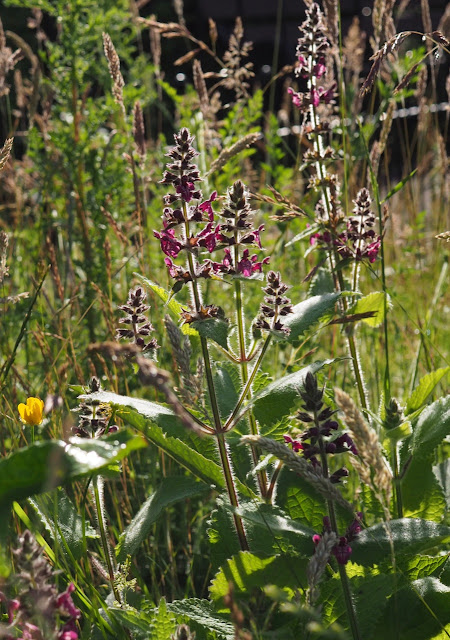
  Stachys sylvaticus A distilled water of the flowers makes the heart merry, to make good a colour in the face and to make the vitall spirits more fresh and lively Nicholas Culpeper 1514-1541  Some people dislike hedge woundwort on account of its unpleasant smell and the nettle-like appearance of its leaves but as long as you don’t crush the leaves you can avoid the smell and although the leaves look nettle like they are pleasantly downy to touch. In fact, I like hedge woundwort and if you get up close to the flowers they have a beauty that is the equal of any orchid. For that reason, you should take time to get at eye level with the flowers and enjoy their rich, marbled purple red colour. Don’t be tempted to pick the flowers or crush the leaves though, on account of that smell. Hedge woundwort in the early morning sun. Taxonomy Hedge woundwort belongs to the Lamiaceae or dead-nettle family, look closely at it and you will see that it has features in common with other family m...
Hogweed

Image
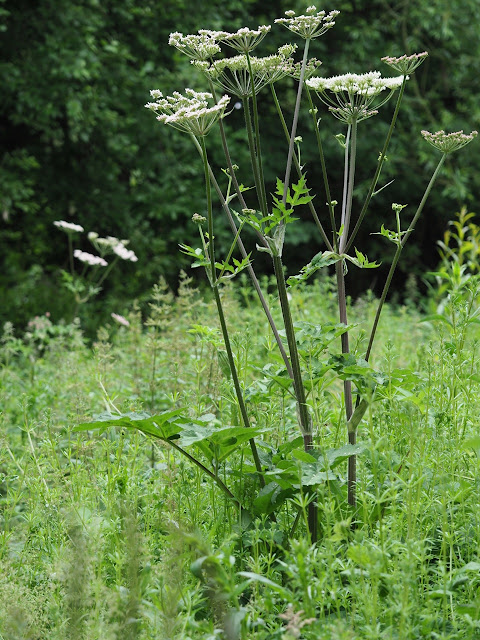
  Heracleum spondylium Despite the unattractive sounding popular name, Hogweed is a magnificent plant whose popular name derives from the unpleasant piglike smell of the flowers rather than reflecting a coarse or ugly appearance. It is the largest of the Apiaceae or umbellifers that are to be found in Leazes Park and in high summer the flat discs of flowers can be above my head. Although you seldom find it in its full glory it does put in an appearance at other times of the year. I have found it during New Year plant hunts and I was prompted to start writing this post by a reappearance of the plant in late October 2020. In spite of the unpleasant fragrance of the mature flowers, the young shoots are supposed to make good eating but I would discourage anyone from eating members of this family harvested from the park. You only have to get it wrong once..... Taxonomy Hogweed belongs to the Apiaceae family that was discussed in a previous blog post. Other members of this family that h...

Wild Carrot

Image
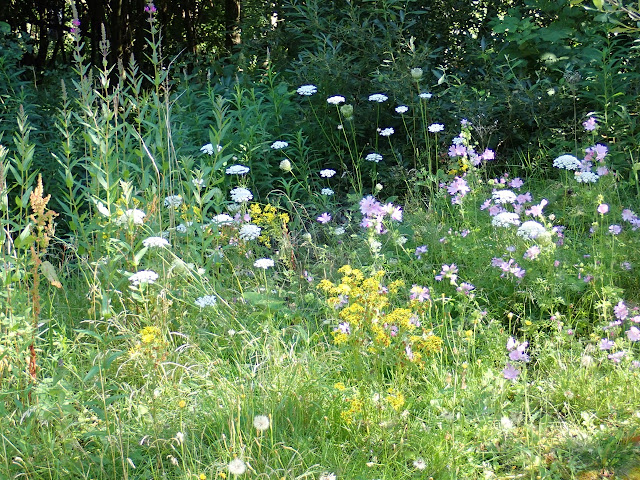
 Daucus carrota                         ............It is a field                         of the wild carrot taking                         the field by force; the grass                         does not rise above it. William Carlos Williams ‘Queen Anne’s Lace’ 1921 One of the most striking and photogenic members of the umbellifers is wild carrot or Daucus carrota and it is a flower that repays regular visits as the inflorescence develops, fades then forms its fruits. Indeed, it is perhaps at its most magnificent in late summer and early autumn when the fruits are forming. Wild carrot normally likes dry chalky soils, in spite of this, there is plenty of it to be found in Leazes Park if you know where to loo...

Fat-hen

Image
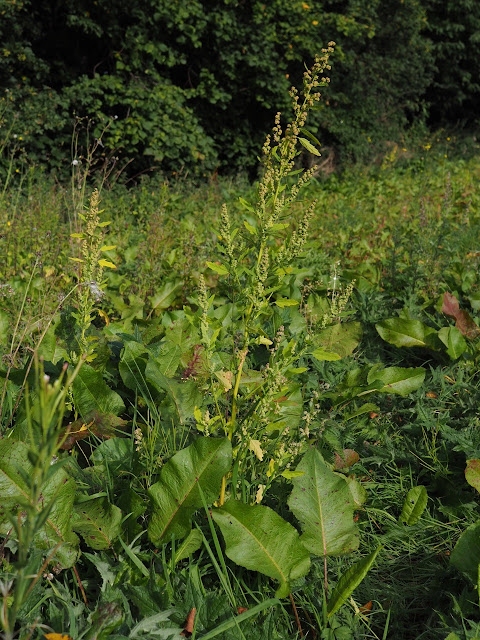
Chenopodium album I'll no more go roaming, no more seeking, No more crushing goosefoot in the wood. With those oatsheaf locks you tossed when speaking You have vanished from my dreams for good. Poem by Sergey Yesenin (translated from Russian). It is easy to walk past this initially inconspicuous and commonplace flower that appears in the park just as summer is coming to a close and autumn is getting started. However, if you do see it you should stop and take a closer look and perhaps come on further occasions and watch it develop. Fat-hen ( Chenopodium album ) growing near Barrack road Taxonomy Fat-hen belongs to what used to be called the Goosefoot family or Chenopodiaceae but is now in the Amaranthaceae. There are a lot of members of this family that can look similar including good King-Henry ( Chenopodium bonus-henricus ), fig-leaved goosefoot (C.ficifolium), nettle-leaved goosefoot (C.murale) and others. Sometimes people give up trying to separate out different members ...

Purple Loosestrife

Image
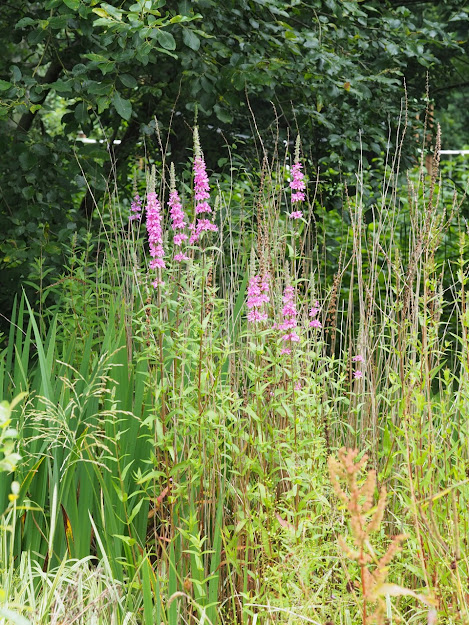
Lythrum salicaria "  I am stark staring mad over Lythrum. For the love of Heaven have look at some of your species and if you can get me some seed, do!" Charles Darwin. Letter to Asa Gray The reason for Charles Darwin's puzzlement will become apparent later but bear in mind that when he wrote this in a letter to the American botanist Asa Gray, he had just finished his book on Orchids so we can be sure he was looking at a deeply mysterious arrangement of flower parts. Taxonomy Purple loosestrife belongs to the Lythraceae family which contains 32 genera and 620 species. The type genus is Lythrum or the loosestrifes. The leaves are typically opposite, simple and with pinnate veins . The flowers are radially symmetric and there are usually six petals which often have a rumpled appearance. The family is also remarkable for heterostyly which will be discussed below. Habit Purple Loosestrife or  Lythrum salicaria  forms tall spires of purple flowers that are u...

Rosebay willowherb

Image
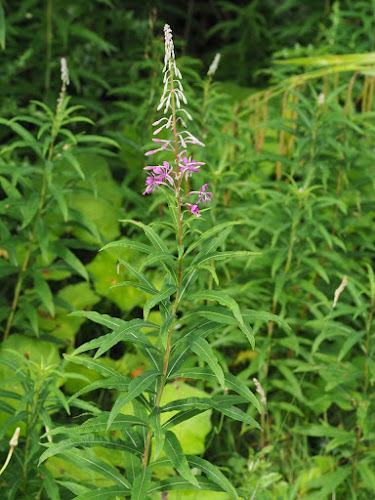
Chamerion angustifolium Rosebay willowherb,  Chamerion  ( Epilobium  in older books)  angustifolium  is one of the more statuesque plants of late summer. Popular names include Bombweed, Fireweed and Ranting Widow. Rosebay willowherb has not always been common and was formerly considered a rare plant. Now, however, it is one the most successful colonisers of wasteland, car parks and railway verges. It may have spread more widely with the opening up of the railways and come late summer you can see why; bursting from the seed capsules are numerous feathery plumed seeds that are easily spread in the slipstream of trains. Like purple loosestrife, rosebay willowherb forms spires of pink/purple flowers and from a distance, they might even look similar but get up close and there should be no confusing the two. 1. Stand of rosebay willowherb. Taxonomy The willowherbs belong to the Onagraceae family. They have 4 petals and 4 sepals arranged with radial symmetry. The ...

Water Figwort

Image
Scrophularia auriculata Neither common nor water figwort can be said to be pretty plants but there is something very striking and almost sinister about them both. The word fig is an old term for piles or haemorrhoids. Possibly the root protuberances or the flower buds resembled piles and on the philosophy of similars, an extract of figwort was a recommended treatment for this unfortunate condition. I have twice been stung by wasps while taking photographs of figworts. For some reason, wasps are attracted to the flowers and they play a role in pollination. Those wasps seem to take exception to some idiot with a camera getting in the way. So, if if you decide to take a closer look - take care. 1. Panicle of water figwort flowers by the lake. Taxonomy Figwort belongs to the Scrophulariaceae family. This family was formerly something of a 'ragbag' of different plants which in many cases did not seem to have a great deal in common. Sure enough, now that we have more gene...