Daucus carrota
............It is a field
of the wild carrot taking
the field by force; the grass
does not rise above it.
William Carlos Williams ‘Queen Anne’s Lace’ 1921
One of the most striking and photogenic members of the umbellifers is wild carrot or Daucus carrota and it is a flower that repays regular visits as the inflorescence develops, fades then forms its fruits. Indeed, it is perhaps at its most magnificent in late summer and early autumn when the fruits are forming. Wild carrot normally likes dry chalky soils, in spite of this, there is plenty of it to be found in Leazes Park if you know where to look. The roots are thin and wiry and bear little resemblance to the orange taproots you can buy in the supermarket. It is thought that the latter was bred from a distinct subspecies that is found in the Mediterranean ssp sativus that, fortunately for us, has a thicker and sweeter root. For that reason do not pull up and eat the roots, they will be bitter and unpleasant. Not only that, if you make a mistake and confuse it with one of the more poisonous members of the family that are to be found in the park, hemlock, for example, you may also end up killing yourself.
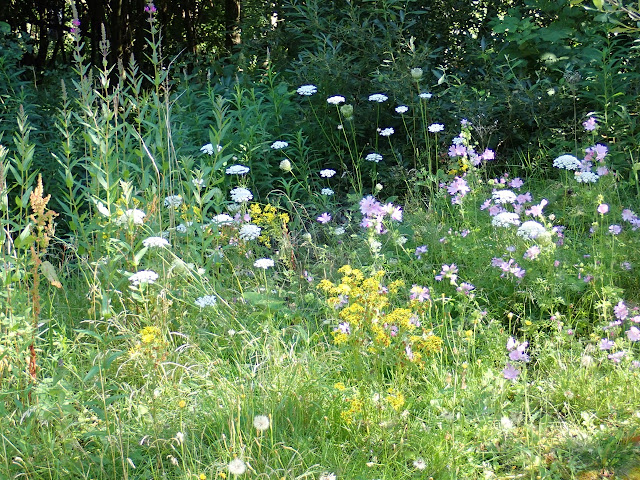 |
Flat-topped white umbels of wild carrot (Daucus carrota) towering above the surrounding grass.
|
Taxonomy
Wild carrot belongs to the Apiaceae a family that was discussed in the blog entry of May 10, 2020. In common with other members of the family wild carrot has flat-topped umbels of flowers and finely divided almost fern-like leaves. The genus Daucus contains about 40 species worldwide.
General Features
Wild carrot is an upright plant reaching about one metre in height. It is not as statuesque as cow-parsley or hogweed perhaps but what it lacks in stature it makes up for in other more delicate features. Unlike hemlock, the stem is furrowed and usually bears short hairs. Also unlike hemlock, there are no purple blotches on the stem. There are one or two flat-topped inflorescences at the top of the stem.
Leaves
The leaves are arranged alternately up the stem. They are finely cut and tripinnate. For me, the appearance of the leaves is an exciting day that promises some magnificent flowers in the weeks to come.
 |
| Finely cut tripinnate leaf |
Inflorescence
The inflorescence is an umbel of umbels, for a more detailed account of this type of inflorescence see the blog post of May 10th
The Carrot Family. What distinguishes the inflorescence from other members of the Apiaceae family are the prominent bracts subtending the primary rays. These are long and divided at their tips. As the inflorescence is developing the bracts form a 'cage' around the immature flowers. Then when the inflorescence opens out into the typical flat-topped plate of flowers the bracts form a ruff around the base of the inflorescence. The bracteoles subtending the secondary rays are undivided and less prominent.
The flowers are initially pinkish in colour and as they mature they become white, except sometimes for the central flower of the inflorescence which retains a reddish-pink colour. To watch this flower unfolding on successive walks is reason enough to make frequent visits to the park.
 |
| Immature inflorescence encased by bracts. |
 |
| The inflorescence unfolds. |
 |
| Initially, the flowers have a pinkish hue. |
 |
| Sometimes the central flower of the umbel remains pink. |
Fruits
You should not give up on wild carrot when the petals start to drop off. The fruiting stage is magnificent and the inflorescence turns into a concave ball of flattened fruits with hooked spines. Once again the bracts wrap themselves around the structure to form what looks like a cage.
Where to find wild carrot in Leazes Park
Good places include the wild area adjacent to castle Leazes moor, the edges of the square area that was formerly a bowling green and the wildflower beds of the Friend Garden; all shown below arrowed in yellow.
 |
Good areas for wild carrot arrowed in yellow
|
Perhaps a little more needs saying about the wild area near the Florid Burn. If you take the path to the left of the 'Blue Waterdrops' sculpture (see picture below) you will come to a small clearing with a pond. You will notice underfoot in places some old tarmac that used to be a tennis court. The area around the pond is a good place for wild carrot and many other interesting flowers.
 |
Follow the path to the left of the blue waterdrops
|


Comments
Post a Comment